
Spotlight on Success
Featured Interview
Tanya Pietrkowski
“Spotlight on Success” is an interview series created by David Levine of I Am Your Virtual Professional. Its purpose is to amplify the voices of today’s business leaders. Each interview provides actionable insights that readers can implement immediately. No fluff, just practical wisdom that enables individuals to move forward with clarity and confidence.

Tanya Pietrkowski


| Company | TP Strategies |
|---|---|
| Role | Nonprofit Fundraising Consultant |
| LinkedIn Profile | https://www.linkedin.com/in/tanya-pietrkowski-8a41196/ |
| Company Website | https://www.tpstrategies.net/ |
Tanya Pietrkowski is the founder of TP Strategies, LLC, and a fundraising and artist consultant with more than 30 years of experience supporting nonprofits, community organizations, legal aid programs, arts organizations, and grassroots initiatives.
She helps mission-driven organizations communicate their value, build trust, strengthen relationships, and create sustainable fundraising strategies. Tanya is also the author of The Unseen Fundraiser, which combines personal stories, professional lessons, and practical guidance from her decades of working with small organizations and the people who keep them moving forward.
Who Should You Nominate?
- Leaders doing meaningful work
- People with insights others can learn from
- Voices worth elevating
Interview Questions
1. What’s one strategy your business used recently that created meaningful growth?
I have allowed myself to grow organically. For instance, when I developed my first book as a conversation starter with small nonprofits, I knew it was time to update my website as well. I’m very pleased with what I see as the growing traction of conversations and relationship growth through this evolutionary process.
2. How has AI or technology changed the way you operate or serve clients?
I like to use AI as a litmus test in messaging. It’s a tool, not a replacement for helping people communicate better and needs to be reviewed with a careful eye. At the same time, AI can be helpful in broadening the topic you are thinking about at the moment
3. What’s one thing you stopped doing that actually helped your business grow?
One thing I have done to help my business grow is create clearer expectations from the outset about the scope of the work and what I can realistically deliver. I prefer to underpromise and overdeliver. My clients’ success directly affects their ability to fulfill their missions. Nothing is more bottom line to me than leaving an organization better positioned to raise money after we have worked together. That starts with building from the strengths and assets they already have.
4. What’s a customer insight you discovered that changed the way you do business?
I have learned that when a potential client asks me to define the “ROI” of my assistance in straight numbers, we may approach the work very differently. Fundraising, visioning and board development are messy, human processes. They require research, navigation, negotiation, risk taking and a willingness to change. If an executive director or board member is looking for a simple formula, or is unwilling to examine the organization’s current culture, my help will only go so far. The organization has to want to grow first. And, sometimes they just aren’t ready.
5. If a business had to improve ONE area to grow faster in the next 90 days, what should it be?
I would focus on messaging. Most nonprofits are so busy fulfilling their missions and putting out fires that they get lost in process-oriented work. They rarely have enough time to stop, think and clearly communicate the impact of what they do. Clear, on point messaging is critical to reaching the people they serve, raising money and building the pipeline of community support they need to grow. I often counsel nonprofits to give themselves grace and simplify their efforts so that they can communicate their work more effectively. How they talk about their services is as important as the services themselves.
6. What’s one thing you do consistently that keeps your pipeline healthy?
I take the time to serve as a sounding board rather than chasing business. I approach every connection as a long-term relationship. Staying helpful and genuinely interested in people and their missions keeps them coming back and referring others when the time is right. I often tell people to wait before hiring me so that they are in the best position possible to roll up their sleeves and get to work.
7. What’s a decision you made in the last year that had a bigger impact than you expected, and what led you to make it?:
Publishing my book was a lovely surprise because of the doors and conversations it continues to open and spawn. I’m having a good time!
8. What’s one process you streamlined that made a noticeable difference in efficiency or results?
I’ve noticed that I like to write things down, and it helps me remember them visually. It’s old school, but it works.
9. What book, podcast, or resource has influenced your thinking or business decisions lately and why?
My book has been a pleasant surprise. I find myself listening to executive directors and hearing them use phrases that I refer to in my book. It has me thinking about my next one that I want to write from the perspective of board members.
Who Should You Nominate?
- Leaders doing meaningful work
- People with insights others can learn from
- Voices worth elevating
I am Your Virtual Professional's
3 Key Takeaways
# 1
Growth can come from creating conversations, not forcing them.
Tanya’s decision to publish her book became more than a finished project it opened doors and sparked conversations. She also describes letting her business grow organically rather than trying to manufacture every opportunity. Her experience shows how sharing useful ideas can become a meaningful source of connection and growth.
# 2
Clear messaging starts with understanding what an organization can realistically deliver.
Tanya emphasizes setting expectations early, avoiding overpromising, and helping organizations build from their existing strengths and assets. She also sees messaging as critical to fundraising and community support: organizations need to clearly explain not only what they do, but why it matters.
# 3
Relationships are the pipeline.
Rather than chasing business, Tanya approaches connections as long-term relationships. She makes herself useful as a sounding board, stays interested in what others are working toward, and trusts that people will remember her when the right opportunity arises. It’s a relationship-first approach to business development built on being helpful before there is a sale.
Who Should You Nominate?
- Leaders doing meaningful work
- People with insights others can learn from
- Voices worth elevating
Join the Spotlight Insider List for early access to new interviews and insights
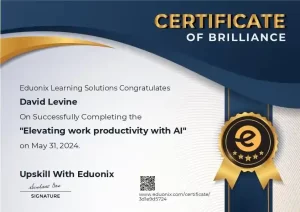
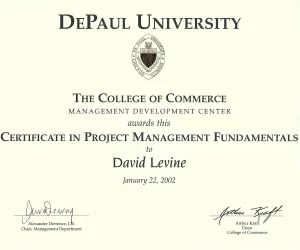
David Levine's Certifications
I am Your Virtual Professional Testimonials
David went above and beyond, building my life coaching website from start to finish. He answered my many questions with utmost patience and was honest if he had any limitations (he’s not a graphic designer but has good recommendations). His humor and charm made him very pleasant to work with. David even made me a glossary of terms when we first started when I said it all sounded like Chinese to me! Each request was honored quickly and efficiently.
Naively I hired a web designer on fiverr and did NOT receive what I asked for. When I turned to David, he listened and worked quickly, revised and reviewed with me the aspects of my website that I wanted changed. He set up Google analytics, my Google Business Profile, SEO, and fixed up the disaster that my website was. He advised on design for business cards and logo. I am extremely satisfied with the work David did and recommend him warmly to whomever wants someone honest, hardworking and efficient.
I had the pleasure to work with David on creating a new landing page for my business. His keen attention to detail greatly enhanced the Content, and his strategic feedback on outreach was invaluable. David is highly knowledgeable and focused on optimizing Content. His prompt responses and insightful suggestions ensured a smooth, efficient process from start to finish. I highly recommend David.
David is thoughtful, thorough, and always does his due diligence to give me 110%. I unequivocally trust him. His attitude rightfully earns everyone’s respect. He quickly got me to the top of page one on Google! He is a true professional and someone that I highly recommend!