
Spotlight on Success
Featured Interview
Chongwei Chen
“Spotlight on Success” is an interview series created by David Levine of I Am Your Virtual Professional. Its purpose is to amplify the voices of today’s business leaders. Each interview provides actionable insights that readers can implement immediately. No fluff, just practical wisdom that enables individuals to move forward with clarity and confidence.

Chongwei Chen


| Company | DataNumen |
|---|---|
| Role | President and CEO |
| LinkedIn Profile | https://www.linkedin.com/in/chcw/ |
| Company Website | https://www.datanumen.com/ |
Chongwei Chen is the President and CEO of DataNumen, a global leader in data recovery software. For over 24 years, he has steered DataNumen’s expansion into the US, the UK, and Hong Kong, serving clients in more than 150 countries. Under Chongwei’s leadership, DataNumen’s solutions have earned the trust of Fortune Global 500 companies—including Toyota, FedEx, HP, Procter & Gamble, and Dell—as well as recognition in hundreds of data recovery books spanning 103 languages.
Who Should You Nominate?
- Leaders doing meaningful work
- People with insights others can learn from
- Voices worth elevating
Interview Questions
1. What’s one strategy your business used recently that created meaningful growth?
We create in-depth technical articles and how-to guides on data recovery, data backup, and data disaster topics — Content that genuinely helps users solve real problems. The results have been threefold: it builds our authority and reputation in the data recovery space, strengthens our site’s domain authority, and drives meaningful improvements in keyword rankings. Most importantly, the traffic it brings is highly relevant — visitors who are already facing the exact problems our software solves.
2. How has AI or technology changed the way you operate or serve clients?
We trained an AI chatbot on our data recovery knowledge base to handle customer questions about our products, and the results have been significant on several fronts. First, users facing a data disaster are usually in urgent need — every minute of data loss matters. Our 24/7 chatbot lets them get real-time, interactive answers immediately, which has reduced support response times and directly contributed to increased sales.
Second, the chatbot handles a large volume of routine inquiries that previously required manual effort, substantially reducing our customer support costs.
Third, we deliberately trained the chatbot to recognize its own limits — when it encounters a question it cannot answer confidently, it directs the user to our human technical support team. This prevents the chatbot from giving inaccurate responses and ensures no customer falls through the cracks. That said, AI chatbots are not perfect. We actively monitor chat logs, and whenever we spot an inaccurate or inappropriate response, we make corrections promptly. Human oversight remains an essential part of making AI work reliably in a customer-facing role.
3. What’s one thing you stopped doing that actually helped your business grow?
We stopped trying to expand into markets outside our core competency. Early on, I made a costly investment in financial instruments during the 2008 crisis — completely outside our domain. Returning our full focus to data recovery and software excellence was the single best growth decision we made.
4. What’s a customer insight you discovered that changed the way you do business?
A seemingly small piece of customer feedback led to a meaningful product improvement — and a lesson I still think about today. Our data recovery product DataNumen SQL Recovery would log a message every time 1,000 records were recovered. When recovering a database with millions of records, the log would display “1000 records recovered” repeatedly for an extended period with no visible change. Several users reported that they thought the software had frozen and stopped working.
Once we understood the issue, the fix was straightforward: we changed the log to display a running total — “Totally records recovered” — a number that increments continuously as recovery progresses. Users could now see real movement happening in real time, which immediately eliminated the confusion. The insight this taught us was that user confidence is as important as technical performance. A product can be working perfectly under the hood, but if users cannot see progress, they lose trust. That shift in thinking — designing for perceived reliability, not just actual reliability — has influenced how we approach user experience across all our products, and it had a direct positive impact on sales.
5. If a business had to improve ONE area to grow faster in the next 90 days, what should it be?
Carefully analyze your core competency — the one thing your business does better than anyone else — and then honestly assess whether the latest AI developments can enhance it. Most businesses either ignore AI entirely or chase AI trends that have nothing to do with their actual strengths. The real opportunity lies in the intersection: applying AI precisely where your expertise already runs deepest. That is where the leverage is greatest and the results are most defensible.
6. What’s one thing you do consistently that keeps your pipeline healthy?
We regularly audit our business processes to identify where AI or automation can meaningfully improve efficiency. This is not a one-time exercise — it is an ongoing habit. As AI capabilities evolve rapidly, a process that had to be done manually six months ago may now be automatable today. By continuously reviewing our workflows with fresh eyes, we free up our team’s time and attention for higher-value work, which keeps the entire business operating with more capacity to grow.
7. What’s a decision you made in the last year that had a bigger impact than you expected, and what led you to make it?:
Seeing others successfully use AI for software development inspired us to try it ourselves for our data recovery tools. Honestly, my initial assumption was that AI could handle only simple programs — the kind of small games like Snake you see in demos. But after experimenting, I was genuinely surprised: AI is fully capable of developing commercial-grade, production-ready software. That realization changed our approach to product development.
We now use AI to build our newer data recovery products, including DataNumen STL Repair and DataNumen FIT Repair. The speed at which we can bring a new product from concept to release has improved dramatically. It was one of those decisions where the upside far exceeded what I had anticipated going in.
8. What’s one process you streamlined that made a noticeable difference in efficiency or results?
Seeing others successfully use AI for software development inspired us to try it ourselves for our data recovery tools. Honestly, my initial assumption was that AI could handle only simple programs — the kind of small games like Snake you see in demos. But after experimenting, I was genuinely surprised: AI is fully capable of developing commercial-grade, production-ready software. That realization changed our approach to product development. We now use AI to build our newer data recovery products, including DataNumen STL Repair and DataNumen FIT Repair. The speed at which we can bring a new product from concept to release has improved dramatically. It was one of those decisions where the upside far exceeded what I had anticipated going in.
9. What book, podcast, or resource has influenced your thinking or business decisions lately and why?
I recommend the I Ching — the Book of Changes — one of the oldest classics in Chinese civilization. At its core, it teaches us the patterns behind how things evolve and transform, and that understanding has been invaluable both in business and in life. Running a data recovery company presents a unique psychological challenge: data recovery is a demand that arises from accidents.
Customers only come to us after a data disaster has already struck, which means our sales are inherently cyclical and unpredictable — there are genuine peaks and valleys, and the valleys can be prolonged. In those difficult periods, I turn to a specific teaching from the I Ching: the relationship between Hexagram 12 (Pi — Stagnation) and Hexagram 11 (Tai — Prosperity). Pi represents bad fortune; Tai represents good fortune. The I Ching teaches that when stagnation reaches its extreme, transformation becomes inevitable — good fortune follows.
This is captured in the Chinese idiom pǐ jí tài lái: out of the deepest stagnation, prosperity is born. That framework has helped me navigate the low points without losing confidence in the long term. I have come through multiple sales downturns at DataNumen, and each time, understanding that difficult periods carry the seeds of the next upswing has made all the difference in how I lead through them.
Who Should You Nominate?
- Leaders doing meaningful work
- People with insights others can learn from
- Voices worth elevating
I am Your Virtual Professional's
3 Key Takeaways
# 1
Depth beats breadth when it’s paired with useful Content. Growth came from doubling down on core expertise—creating genuinely helpful technical Content that attracts the right customers already facing the problem, strengthening both authority and pipeline quality.
# 2
AI works best when embedded into real workflows, not bolted on. From customer support chatbots to accelerating product development, the gains came from applying AI where it reduces friction, handles volume, and augments human judgment—not replacing it.
# 3
Customer confidence is a growth lever, not a byproduct. A simple UX shift, showing real-time progress instead of static updates transformed trust and reduced churn, reinforcing that perceived reliability can matter as much as technical performance.
Who Should You Nominate?
- Leaders doing meaningful work
- People with insights others can learn from
- Voices worth elevating
Join the Spotlight Insider List for early access to new interviews and insights
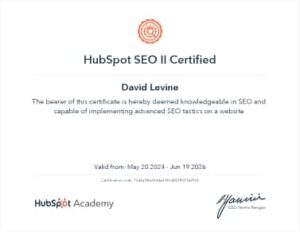
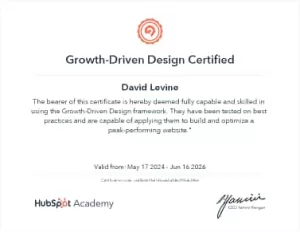
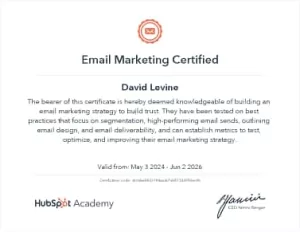
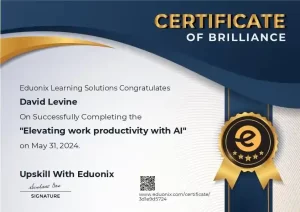
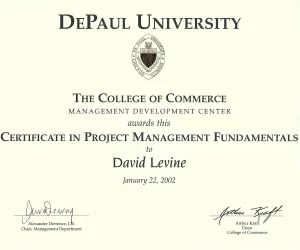
David Levine's Certifications

I am Your Virtual Professional Testimonials
David went above and beyond, building my life coaching website from start to finish. He answered my many questions with utmost patience and was honest if he had any limitations (he’s not a graphic designer but has good recommendations). His humor and charm made him very pleasant to work with. David even made me a glossary of terms when we first started when I said it all sounded like Chinese to me! Each request was honored quickly and efficiently.
Naively I hired a web designer on fiverr and did NOT receive what I asked for. When I turned to David, he listened and worked quickly, revised and reviewed with me the aspects of my website that I wanted changed. He set up Google analytics, my Google Business Profile, SEO, and fixed up the disaster that my website was. He advised on design for business cards and logo. I am extremely satisfied with the work David did and recommend him warmly to whomever wants someone honest, hardworking and efficient.
I had the pleasure to work with David on creating a new landing page for my business. His keen attention to detail greatly enhanced the Content, and his strategic feedback on outreach was invaluable. David is highly knowledgeable and focused on optimizing Content. His prompt responses and insightful suggestions ensured a smooth, efficient process from start to finish. I highly recommend David.
David is thoughtful, thorough, and always does his due diligence to give me 110%. I unequivocally trust him. His attitude rightfully earns everyone’s respect. He quickly got me to the top of page one on Google! He is a true professional and someone that I highly recommend!